
Amplifying Productivity via Collaborative Efficiency
TIMELINE
8 Weeks
TEAM
2 Designers, PM
INDUSTRY
B2C, B2B
MY ROLE
UX Research, Task flow, CA, Ideation, Design System, Wireframing, Prototype Testing
Introduction
DiveIn Media, a influencer marketing firm, specializes in connecting brands with relevant influencers to engage millions of audiences. Renowned brands like Baidhyanath, kukuFM, and relevel by unacademy among others are the notable brands. In this project, we've developed a collaborative platform aiming to boost productivity, enhance user engagement, save time, and streamline communication.
Overview & Context
This case study outlines the platform's targeted resolution of challenges faced by stakeholders engaged in campaign creation and collaborations—be it brands, administrators, managers, or influencers. These improvements have resulted in significant enhancements in efficiency, engagement & collaboration
Challenges
INTERNAL TEAM
Communication Overload
Extensive back-and-forth communication leads to delays and inefficiencies.
Outdated Influencer Profiles
Lack of updated information in Excel sheets requires manual exploration of relevant data.
Absence Handover Uncertainty
An unclear handover process during absence leads to disruptions.
Time-Consuming Shortlisting
Lengthy process impacts productivity and challenges in narrowing down influencers within broad categories.
Challenges in narrowing down influencers within broad categories. Backed-out influencers require redoing the entire shortlisting process.
Customization of Campaign Briefs
Need for uniform briefs for multiple influencers opting out of specific deliverables.
Campaign Tracking Challenges
Difficulty in segregating and tracking deliverables for influencers and managers.
INFLUENCER
Incomplete Campaign Information
High-demand periods and inconsistencies in available campaign counts present significant challenges in effectively sourcing campaigns.
Niche-Aligned Brand Partnerships
Difficulty in finding suitable brand partnerships aligned with the influencer's culinary niche. Struggle in sourcing relevant products for content creation. Seeking connections with pertinent brands for collaborations.
Rejecting Campaign Offers
Turning down campaigns due to conflicting terms of the influencer then the brand.
Communication Challenges
Dependency on phone calls for sponsorship, leading to prolonged discussions.
Content Creation Inefficiency
Challenges in organizing, editing, and scheduling culinary content.
Brand Alignment and Analytics
Assessing brand fit and providing performance analytics to brands.
PROBLEM STATEMENT
Internal teams grapple with communication overload, outdated profiles, absence handovers, and cumbersome shortlisting. Influencers face incomplete campaign details, partnership hurdles, product sourcing challenges, and inefficient communication. This results in reduced efficiency, engagement, and productivity.
Goals
BUSSINESS GOALS
Operational Efficiency Enhancement
Streamlining internal processes to improve productivity and reduce inefficiencies.
Boosting Collaboration and Engagement
Implementing strategies to improve overall productivity
Time-saving in Influencer Management
Optimizing processes to save time in managing influencers.
USER GOALS
Efficient Campaign Participation
Streamlining the process of participating in campaigns by obtaining comprehensive and accurate campaign details upfront, especially during peak demand periods, to facilitate smoother engagement.
Securing Niche-Aligned Brand Partnerships
establish partnerships with brands that align with their specific niche or expertise, ensuring authenticity and relevance in their content creation.
Managing Campaign Terms
Evaluating and aligning campaign terms and conditions to their brand persona, ensuring they resonate with the influencer's image and values.
Improving Communication Channels
Seeking efficient and effective modes of communication with brands and sponsors, reducing reliance on time-consuming phone calls for sponsorship discussions.
Enhancing Content Creation Process
Improving the content creation process involves streamlining workflows for better organization, editing, and scheduling. It aims to offer flexibility in deliverables and enhance overall efficiency in content creation.
Establishing Brand Alignment and Providing Analytics- Future Scope
Evaluating brand compatibility and providing performance analytics to brands, ensuring alignment with their influencer persona and audience engagement metrics.
Key Solutions
Accurate campaign details

Upfront Influencer details


Securing Niche-Aligned Brand Partnerships
Campaign Terms & conditions to both

Improving Communication Channels

Enhancing Content Creation Process


Design Process
PROJECT BACKGROUND
Eco System Mapping
Gantt chart
Competition Analysis
USER UNDERSTANDING
User Interview
User Archetypes
Thematic Analysis
Affinity Mapping
Key Pain Points
DESIGN
How Might We
Task Flow
Mid Sketch
Design System
Final Designs
BACKGROUND
Process Overview
The project overview indicates an initial exploration phase, focusing on comprehending the existing ecosystem. This phase involved a thorough examination leading to the identification of several insights and pain points within the system.

Gantt Chart
Initially, I created a project plan for eight weeks. Then, for weeks two to three, we focused on researching and gathering a lot of data. In the final five weeks, we analyzed all the information to create design recommendations. Even though there were some changes and overlapping tasks, we successfully delivered results that aligned closely with my initial vision. Most of the time went into understanding users and there tasks, The gathered data was utilized, undergoing multiple iterations for refinement and improvement

Competition Analysis
We utilized Figjam, a remote collaboration tool, to gather inspiration from innovative brands regarding their platform and business model. We categorized our findings into three sections: general information, design analysis, and detailed insights about the product.

USER UNDERSTANDING
Our Users
Before diving into the design phase, we undertook an extensive analysis of user behaviors, task priorities, and challenges. This involved conducting a series of interviews aimed at comprehending the unique traits of each archetype.
Our primary objective was to identify the core tasks executed by each archetype and recognize any limitations or challenges they encountered. Subsequently, we classified users into three distinct archetypes—Campaign Manager, Admin, and Influencer—and aligned their roles with specific tasks to be accomplished within the system.

Campaign Manager
The Campaign Manager, within the context of influencer marketing, typically handles the planning, execution, and monitoring of influencer campaigns on behalf of brands or companies. They manage the entire campaign lifecycle and ensure successful collaborations with influencers to meet the brand's objectives.
JOBS TO BE DONE
Monitoring Campaigns, Influencer selection, Coordinating influencers, Determining target audience, Negotiations with influencers, Campaign Performance Analysis, Reports on campaign performance

Admin
Admin typically serves as an administrative figure responsible for managing the operational aspects of the platform or system used for influencer campaigns.
JOBS TO BE DONE
User management, Platform maintenance, Data organization, Troubleshooting platform issues, Approving influencer onboarding requests, Managing user permissions, Brand collaboration

Influencer
Creates content and engages with an audience on social media platforms. Their primary role revolves around creating engaging content, promoting products, services & brands, and building a loyal following.
JOBS TO BE DONE
Content creation, Audience engagement, Partnering/Collaboration with brands/ Agencies, Promoting products/services, Building and maintaining a follower base, Analyzing campaign performance.
Thematic Analysis & Affinity Mapping
In the design process of user understanding, following interviews with the campaign manager, influencer, and admin, thematic analysis and affinity mapping were conducted to distill key challenges or bottlenecks. Subsequently, as team we derived insights into major pain points or challenges of each archetype.
This process involved converging initially, where findings from the thematic analysis and affinity mapping were focused on identifying the main pain points. This approach helps reframe identified issues as actionable problem statements, stimulating creative thinking to generate innovative solutions.

Some snippets from data synthesis & insight generation
Key Pain points Internal Team
Lack of functionalities in the user experience tailored to the identified personas, hindering efficient workflow.
Difficulty in monitoring and tracking influencer tasks, pricing strategies, and determining Return on Investment (ROI).
Manual maintenance is required for an extensive and organized list of influencers, lacking streamlined data management.
Inadequate record-keeping for communication with creators, including campaign briefs, pitches, and contracts.
The absence of a centralized library to access influencer content posted during campaigns affects reference and analysis.
Absence of a comprehensive database to track influencer performance metrics, such as engagements, revenue, and post count, creates challenges in assessing campaign success.
Unclear handover processes during absence lead to disruptions in workflow and productivity.
Lengthy and laborious influencer shortlisting processes, particularly within broad categories, cause inefficiencies.
Communication inefficiencies, especially extensive back-and-forth communication, and the need for uniform briefs across multiple influencers opting out of specific deliverables hindering campaign management.
Key Pain points Influencer
Lack of upfront information regarding campaign requirements, leading to inundation with last-minute requests during festivities and difficulty finding campaigns or relevant products during non-festive periods.
Desire for reliable brand partnerships aligned with their niche, but challenges in finding suitable collaborations
Difficulty in searching for high-quality and relevant products for content creation.
Rejection of campaign offers due to conflicting terms and conditions that don't align with the influencer's requirements.
Dependence on direct communication via calls with brands for sponsorships, resulting in time-consuming back-and-forth discussions.
Struggle in streamlining the creation, editing, and scheduling of content, requiring better workflow management.
Desire for access to a network of relevant brands and businesses for partnership opportunities.
Evaluation of brand products, values, and objectives to ensure alignment with the influencer's culinary niche and persona.
Providing brands with performance analytics, including engagement metrics and reach, might be a complex task without proper tools or systems in place.
DESIGN
How Might We
In tackling the outlined case study, we utilized the "How Might We" approach to brainstorm solutions across various affinity mapping categories
-
Enhancing system transparency to provide clearer insights within the platform.
-
Resolving sorting issues to streamline and simplify processes.
-
Improving communication for more efficient and effective interactions.
-
Developing advanced solutions for managing complex workflows.
The outcomes from these solutions were segmented into two phases: the Minimum Viable Product (MVP) stage and Phase 2, encompassing an expanded feature set. During this process, we ensured to assess the feasibility in terms of business, user, and technical aspects.

Task Flow
We mapped each archetype to their envisioned user journey
Admin

Campaign Manager

Influencer

Mid Fidelity Wireframes

Iteration Explored
The designs have gone through a lot of iterations on many screens. It is due to several reasons like Change in business direction, shift in product roadmap or simply to improve the user experience.
Influencer
DISCARDED
We discarded the idea of having campaign details under the 'opted' tab for influencers. It lacked a space to view the old negotiation history, which was considered crucial for influencers' which lacked clarity and transparency in discussions
Campaign Details
FINALIZED
The iteration included a 'bid history' section for influencers negotiating with a brand for the second time. This addition aimed to provide influencers with a historical reference to gauge progress, ensure clarity in terms, and tactics for negotiation, and consideration of legal and contractual aspects
Campaign Details
After completing campaign deliverables, users return to the campaign list page and proceed directly to the 'ready to go live' section, marking the campaign as finished. However, requiring influencers to upload the live link for finalizing the deliverables within the campaign list page tab ('Ready to go live') contradicts the principle of proximity in UX design, leading to confusion among users
The campaign deliverables section includes the need for a live link. Tabs within the campaign deliverables section allow users to track the completed deliverables' status without navigating away from the campaign. However, users perceive deliverables inside the campaign as linked. The campaign page's tabs display the campaign status, creating a perception clash in users' mental model
Ready to go live
Ready to go live
Campaign Manager
DISCARDED
FINALIZED
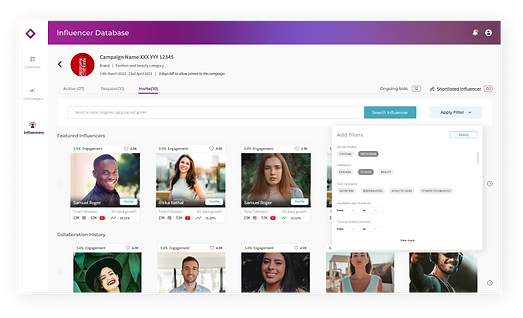
In each campaign, the Campaign Manager (CM) can view influencers associated with the campaign through tabs such as active, request, and invite. When initiating an invitation to an influencer, the CM needs to obtain confirmation from the brands before finalizing, resulting in a time-consuming and manual process.
The feature enables Campaign Managers (CMs) to shortlist influencers themselves. Additionally, there's a separate tab for brand-approved candidates, and both lists can be downloaded. Onboarding brands in phase 2 will enhance scalability and efficiency, saving valuable time
Brand Approved List
Brand Approved List
Admin
DISCARDED
FINALIZED
The admin's role is limited to observing the campaign status, overseeing the participants, and granting approvals, such as onboarding influencers into campaigns. Campaign creation is handled by the campaign manager. However, this arrangement can result in issues since the campaign manager needs to gather briefs from brands, potentially causing privacy concerns and other related issues.
The recent business decision involves enabling admins to create campaigns without requiring approval requests. Additionally, admins will have the ability to reassign campaigns to other campaign managers, aiding in situations where a manager is unavailable due to leave or aids in handovers. Campaign managers will negotiate with influencers, and the final list will only be approved by brands before negotiations proceed. This alteration aims to improve admin understanding of campaign and brand objectives, offering brands a single, centralized contact point for smoother interactions and reduces privacy concerns. -
Campaign Creation
Campaign Creation
Design System
We crafted a design system for the client's platform that resonated with the product concept and brand essence. Our agreement on the brand colors, embodying values such as care, collaboration, responsibility, and joy, mirrored our objective of achieving a premium brand positioning. The resulting style guide serves as an extensive reference for platform branding and its various components. Among the numerous components developed, here are a few showcased examples.
Foundation
Colors

Typography

Grid

Components
Buttons

Tabs

Header

Cards

Side Panel

Final Designs

Note: There are over 150+ screens for each archetype, logo, and other details, with some information modified to comply with the non-disclosure agreement.
Takeaways
-
Balancing interview questions: Incorporating a mix of open-ended and closed-ended questions during interviews can efficiently gather detailed information while saving time.
-
Embracing adaptability: Being prepared to handle abrupt changes in business decisions or project structures is crucial for flexibility and maintaining a smooth design process.